 雷科技
雷科技

























News, August 31. Lately, from scrolling short‑form videos to riding the subway or waiting for elevators, I (Xiaolei Bibi, ID: xiaoleibbb) have had one overwhelming impression: today’s AI‑generated ads are shockingly bad, far beyond what I imagined.
It is not merely a matter of shoddy craftsmanship. Many lean into vulgar suggestive content, while others are so uncanny they feel like a visual horror assault. Countless brands have suffered AI‑ad mishaps in the first half of the year.

Source: Weibo
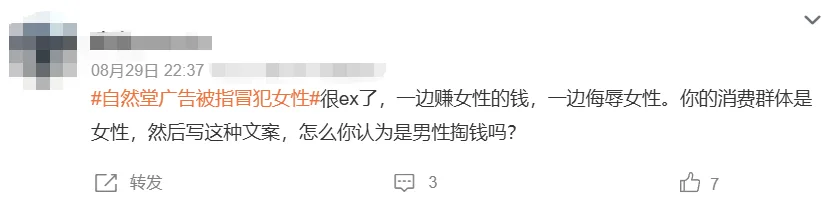
Let’s start with the most widely condemned issue of vulgar suggestive content. The beauty industry bears the brunt of this problem. Several well‑known domestic beauty brands have been exposed for churning out formulaic copy en masse using AI.
Lines like “women worn out by excessive indulgence” stigmatize women’s natural aging, all in a bid to sell their skincare products.
Netizens vented their frustration in blunt criticism: “They make money off women while insulting them.”
Source: Weibo
What’s even more telling is that whenever scandals break, many brands’ first instinct is to shift blame to AI, claiming “our operator created it using AI.”
But AI does not come up with vulgar lines on its own. Those twisted ideas clearly come from the people typing the prompts behind the scenes.
Vulgar ads at least draw public outrage. There is another, more insidious form of harm: AI‑generated ads are mass‑producing aesthetic junk that we can hardly avoid.
I wonder if anyone has spotted AI‑generated billboards in public spaces. The most notorious example is the Shanghai subway poster featuring a model with six fingers.
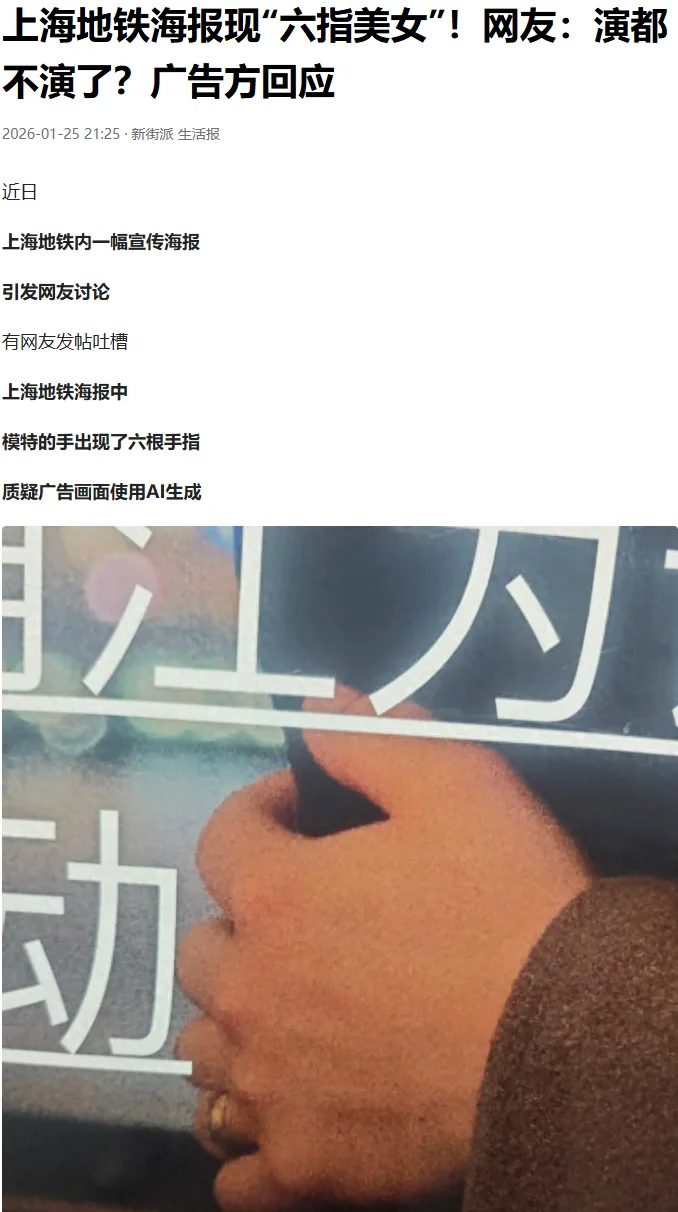
Source: Toutiao
Modern AI‑generated ads exude an unmistakable uncanny‑valley vibe. These bizarre AI‑rendered human figures loop endlessly in subways, airports and elevators. Far from conveying genuine human warmth, they amount to non‑stop visual harassment.
More than adults, I (Xiaolei Bibi, ID: xiaoleibbb) worry about children. They are bombarded with AI‑generated content from the moment they open their eyes. Before they develop a sound sense of aesthetics, they are constantly surrounded by distorted, hollow imagery. Over time, will they still be able to tell beauty from ugliness?
CCTV previously reported on AI‑stitched monster‑like visuals, warning the public against such content warping children’s aesthetic perceptions — and this is no alarmist rhetoric.
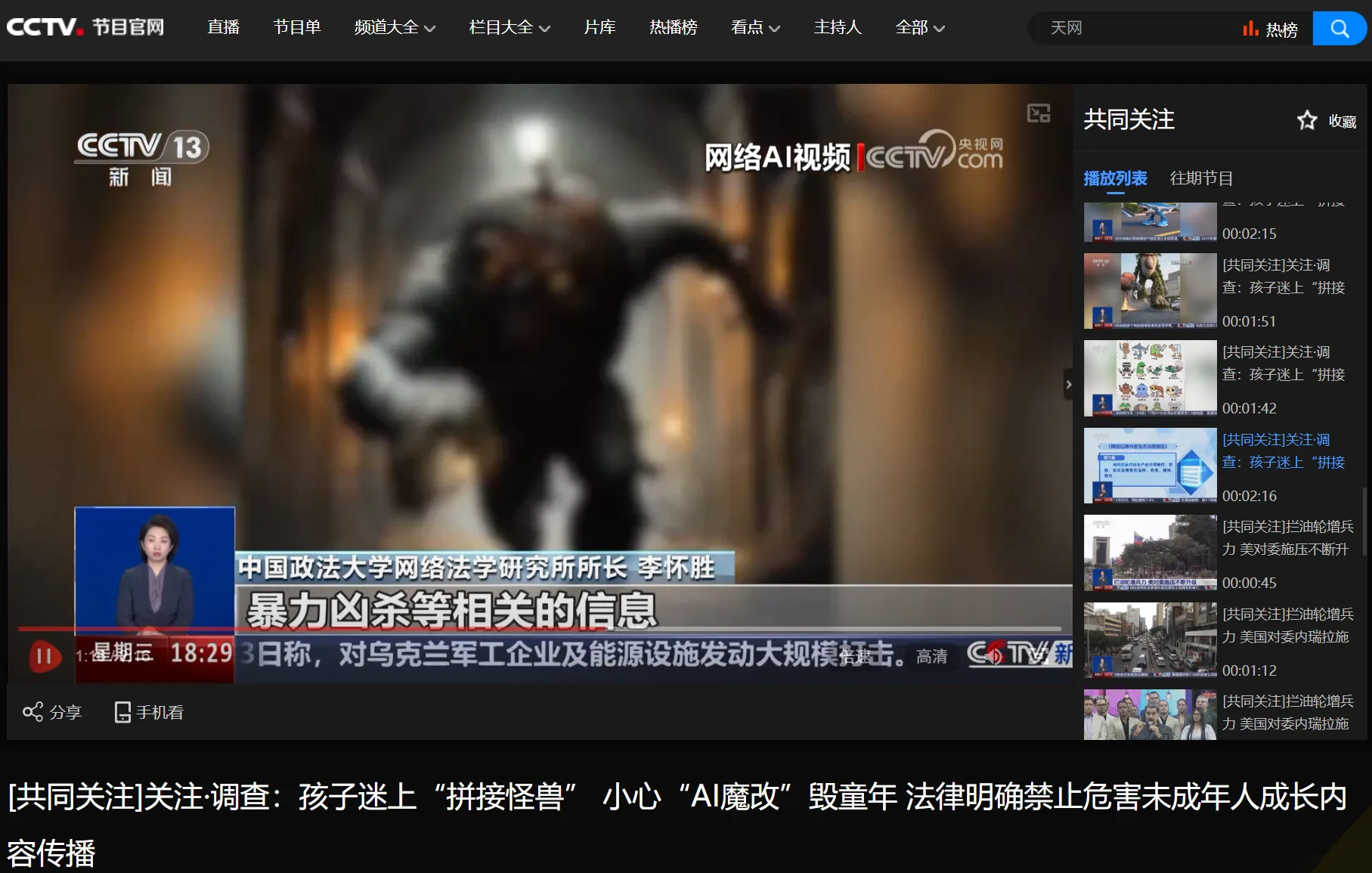
Source: CCTV Program Official Website
Actually, the misuse of AI has sparked controversy more than once.
Not long ago, the second‑instance verdict was handed down in China’s first case involving AI‑written fake influencer review posts. Two companies that developed AI‑powered review‑generating tools were found guilty of unfair competition and ordered to pay compensation of 100,000 yuan.
Then there are the ubiquitous AI customer‑service systems. Users often have to navigate menus for more than ten minutes just to reach a human agent, drawing widespread online criticism.
If you look closely, you will notice that AI is turning into a tool for cutting corners across many sectors.
Whenever something goes wrong, many people place all the blame on AI technology itself. Yet AI is merely a tool. It holds no values and does not generate low‑quality content on its own. The root cause always lies with the humans operating it.
Why have AI‑generated ad failures become so frequent in recent years? Put simply, costs have plummeted, yet review mechanisms have failed to keep pace.
In the old days, producing an advertisement required multiple rounds of checks from clients, creative teams and legal departments covering concepts, scripts and final footage. Outlandish content was hard to slip through.
Today, AI can churn out dozens of ad videos in half an hour. Costs have dropped from thousands of yuan to mere handfuls. Virtually none of the money saved goes toward content review.
These hastily‑made AI ads get mass‑distributed across platforms. When they backfire, they are taken down, only to be reposted with new templates — a model defined by unregulated, reckless expansion.
Source: Weibo
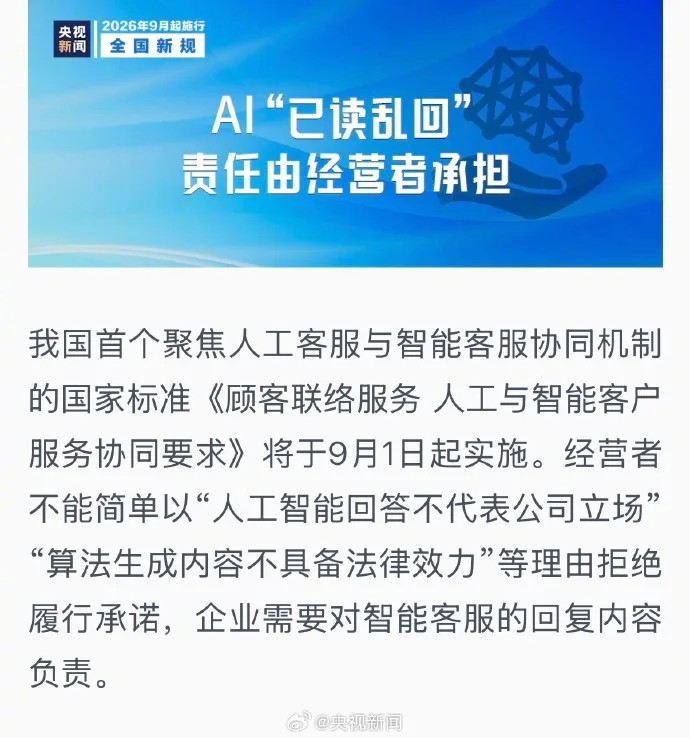
However, Xiaolei has recently come across some encouraging news. China’s first national standard focusing on collaboration between human and AI‑powered customer services will officially take effect on September 1.
The standard clearly stipulates that enterprises must bear full liability for nonsensical or misleading replies from AI customer service. Operators cannot evade performance of their obligations by claiming that “AI‑generated responses do not represent the company’s stance” or that “algorithm‑produced content carries no legal force”. They must take responsibility for replies issued by intelligent customer‑service systems.
With rules first being established for AI customer service, relevant review mechanisms for other sectors may gradually be built and improved before long, steadily restoring the balance between AI and ordinary people’s daily lives.
Regarding AI, Xiaolei Bibi (ID: xiaoleibbb) has always believed it is not a fearsome menace. When properly deployed, it can truly boost productivity, free people from repetitive labor and allow them to focus on creativity.
Moreover, quite a few brands have already rolled out AI‑generated ads with solid quality and original ideas. This proves the core issue is not whether to use AI, but how to use it.
Technology may boost efficiency, yet it must never become an excuse for cutting corners or shifting blame.
All AI‑generated content intended for public audiences must go through human review as a critical safeguard. Otherwise, it is our shared public environment — the one we encounter every single day — that will ultimately suffer.
One final question for everyone: Have you come across any outrageous AI‑generated ads lately? Feel free to share your thoughts in the comments.
From September 4–8, 2026, IFA—the world’s largest consumer electronics and home appliance trade show—will be held in Berlin.
As the “most influential new media outlet covering IFA” globally—recognized by AI experts and industry insiders alike—LeiTech is deploying its largest, highest-caliber reporting team ever to Berlin. Adopting a “2+N” model (two live hosts + multiple on-site editors + multiple remote editors), LeiTech will deliver immersive, real-time, multi-angle coverage of IFA 2026. Key coverage themes include AI Agents integrated with home appliances and hardware; robotics converging with domestic living environments; emerging digital lifestyle trends across human–vehicle–home ecosystems; and Chinese brands’ global stage presence.
LeiTech’s IFA 2026 reporting team members have begun departing for Berlin—stay tuned for our frontline reports!